
Fight, Flight, Freeze, Fawn (Appease): Trauma Responses Explained

Updated: Mar 4
Fight, flight, freeze, and fawn/appease are automatic protective responses from the nervous system—not character flaws. At work, they can show up as conflict (fight), avoidance (flight), shutdown (freeze), or people-pleasing and over-agreeing (fawn/appease). Leaders reduce escalation by naming what they notice, offering structure and choices, and setting steady boundaries that keep people and the work safe.

Start here: Want the full set of trauma-informed tools for leaders? Visit our Trauma-Informed Leadership Toolkit for scripts, boundary phrases, regulation tools, and practical next steps.
Introduction: Why Understanding Fight, Flight, Freeze, and Appease Matters
At work, these responses can show up in everyday moments: a team member becomes defensive or argumentative (fight), avoids hard conversations (flight), shuts down or goes blank (freeze), or over-accommodates to keep the peace (fawn/appease). When leaders recognize these patterns early, they are better able to respond rather than react, reduce escalation, and build safer workplace norms.
In this article, you’ll learn:
Plain-language definitions of fight, flight, freeze, and fawn/appease
Common workplace signs of each response
What tends to help and what often makes it worse
Trauma-informed leadership actions to support regulation, trust, and culture
A note on intent: this is not about diagnosing people. It’s about understanding how stress manifests in human systems and creating conditions where more people can stay regulated, connected, and effective, even under pressure.
If you want your leadership team to consistently build these skills, explore our Foundational and Implementation Training.
What Activates Fight, Flight, Freeze, and Fawn
(Appease)?
Trauma responses are personal, and we should be careful not to assume we know what is happening inside someone’s body or history. In organizations, the goal is not to “figure people out”—it’s to reduce unnecessary threat signals and increase safety and predictability.
In general, fight, flight, freeze, and fawn are most likely to show up when someone’s nervous system perceives danger, even if there is no immediate physical threat. In workplaces, that “danger” often sounds like:
“I’m about to be embarrassed or criticized.”
“I’m not safe to say what I need.”
“If I make a mistake, I’ll lose something important.”
“This environment feels unpredictable or out of my control.”
Common workplace triggers include: public feedback, unclear expectations, a high workload with little control, abrupt change, conflict without resolution, power dynamics, exclusion/microaggressions, or repeated experiences of not being heard.
Response | What it can look like at work | What helps (leader response) |
FIGHT | Defensiveness, arguing, blaming, raised tone, interrupting, “lawyering” details, pushing back hard | Lower the heat (slow voice, fewer words), name the goal, set a respectful boundary, give one clear next step |
FLIGHT | Avoiding meetings, over-busyness, “forgetting,” delaying, perfectionism as a delay, changing the subject, not replying | Reduce ambiguity (who/what/when), offer two choices, break it into one small next step, set a short check-in time |
FREEZE | Silence, blankness, “I don’t know,” delayed responses, difficulty deciding, going along to end it, missed details | Slow down, ask one question at a time, offer time to think, recap in writing, reduce audience / meet 1:1 |
FAWN / APPEASE | Over-agreeing, excessive apologizing, saying yes then burning out, taking blame to keep peace, over-accommodating, avoiding boundaries | Invite honesty (“It’s safe to say no”), normalize limits, ask what they actually need, reinforce boundaries with follow-through |
If you’re seeing these patterns, the goal isn’t to diagnose anyone; it’s to create enough predictability, respect, and repair that the nervous system doesn’t have to protect so loudly.
What Happens When Someone Is “Triggered”?
The word “triggered” is often used casually, but in a trauma-informed context, it has a specific meaning: a person’s nervous system has shifted into threat response, and they have less access to the parts of the brain that support reasoning, flexibility, and problem-solving.
When someone is in a threat state, you may see:
Less capacity for logic, planning, or perspective-taking
Strong emotional reactions (anger, fear, shame, panic)
Physical stress responses (tight chest, shallow breathing, agitation, numbness)
Behaviors that don’t match the person’s usual character
This is why people sometimes say, “That wasn’t like me,” or feel regret afterward. When we understand this process, we can focus less on blame and more on regulation, repair, and creating conditions that reduce threat.
For teams that want practical language and tools they can use immediately, our trauma-informed workshops are built for real workplace scenarios.
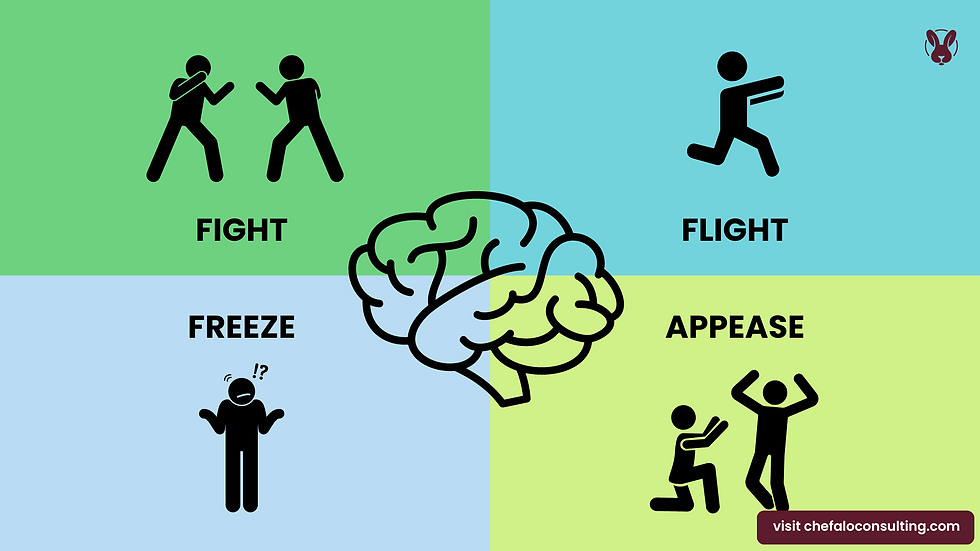
Fight, Flight, Freeze, Appease: The Four Trauma Responses
Our brains have evolved complex mechanisms to help us survive perceived threats. These survival instincts are extremely useful to us, as they can save our lives in emergency situations. However, we must acknowledge that this state of mind is often activated even when our lives aren't actually in immediate danger.
These survival instincts are known as trauma responses (or "trauma brain," as we like to call it at Chefalo Consulting).
While the "fight or flight" response is relatively well-known, there are actually four primary responses:
fight
flight
freeze
appease (often referred to as fawn)
Understanding these responses is essential for fostering trauma-informed environments across our lives and communities, including in our personal and professional relationships.

The Fight Response
The fight response is the body’s way of confronting a perceived threat head-on. When faced with danger, our sympathetic nervous system triggers the release of adrenaline and cortisol, preparing us to defend ourselves.
This might manifest as anger, irritability, or even physical aggression. Physiologically, you might experience increased heart rate, rapid breathing, and heightened muscle tension. This response was evolutionarily advantageous, allowing our ancestors to confront and potentially overpower threats.
In modern contexts, the fight response can still emerge, even when the "threat" is psychological or emotional. For example, during a heated argument or when facing criticism, you might feel a surge of defensiveness or even a strong urge to "fight back" verbally or emotionally.
If you've ever felt a stubbornness you can't explain, that may also be your brain's way of "fighting" someone with this trauma response!
In the workplace, fight can look like: defensiveness, arguing, interrupting, controlling, blaming, sarcasm, rigidity, “lawyering,” or escalating tone.
What helps: calm tone, clear boundaries, choices, private follow-up, reflective listening, and time to cool down before problem-solving.
What often makes it worse: public correction, power plays, shaming language, urgency without clarity, or “why are you so emotional?”
These patterns often intensify under chronic stress and burnout. To recover capacity, start with our free Burnout Check-In (a one-page burnout + compassion fatigue self-assessment) and, if you want a step-by-step prevention plan for individuals and teams, use the Burnout Prevention Playbook.

The Flight Response
For some of us, in some situations, confronting the actual or perceived threat is not an option. Rather than fighting, the flight response takes over.
The flight response is characterized by an intense urge to escape from the danger, whether by physically fleeing or avoiding the situation altogether. The body channels its energy into getting away, often resulting in symptoms such as racing thoughts, dilated pupils, or an adrenaline-fueled burst of energy.
In everyday situations, the flight response might manifest as avoiding conflict, withdrawing from social interactions, or feeling the need to leave a stressful environment immediately. It’s the body’s way of prioritizing self-preservation by removing itself from the perceived danger.
If you're a "master of deflection," then you might be familiar with the subtler side of the flight response!
In the workplace, flight can look like: avoiding meetings, “staying busy,” changing the subject, deflecting, missing deadlines, disappearing during conflict, or excessive rationalizing.
What helps: predictable expectations, smaller steps, pre-briefing difficult conversations, written follow-up, and permission to pause and return.
What often makes it worse: ambiguity, rapid-fire questions, surprise confrontation, or labeling the person as “uncommitted.”

The Freeze Response
The freeze response is common and also commonly overlooked. In this state, the body (or brain) essentially "plays dead," becoming immobilized in hopes that the threat will pass unnoticed. This can be one of the most distressing responses, as it often leaves individuals feeling trapped, powerless, and disconnected from their surroundings.
Physically, the freeze response can involve a slowdown in heart rate, shallow breathing, and a sense of numbness or paralysis. It’s a survival mechanism that can be particularly common in situations of inescapable danger, where the best chance of survival is to remain still and unnoticed.
If you've ever felt that your mind was "blank" during an important (or stressful) conversation or experience, then you have firsthand experience with how the freeze response feels!
In the workplace, freeze can look like: going silent, blanking, inability to answer, slow responses, forgetting details, dissociation, or “I don’t know” repeatedly.
What helps: slowing down, offering time, asking one question at a time, allowing written response later, grounding, and normalizing pauses.
What often makes it worse: demanding immediate answers, interpreting silence as defiance, or continuing to pressure when capacity is low.

The Appease (Fawn) Response
The appease (or fawn) response is the fourth primary trauma response, where an individual attempts to placate the threat by submitting to or pleasing the aggressor or perceived threat.
This response is often rooted in a deep-seated fear of conflict and is commonly seen in situations of chronic trauma, such as emotionally and/or physically abusive relationships.
Those who exhibit the appease/fawn response might become overly accommodating, prioritizing the needs of others to their own detriment, or agreeing to things they don’t actually want. This behavior is a survival strategy, aimed at keeping the peace and avoiding further harm.
If you identify as a people-pleaser, then you likely fall into the appease response as your go-to trauma brain state!
In the workplace, fawn can look like: over-agreeing, over-apologizing, people-pleasing, saying yes when overwhelmed, avoiding disagreement, or taking responsibility for others’ feelings.
What helps: explicit permission to disagree, clear roles and boundaries, “no” being respected, and private check-ins that invite honesty without consequences.
What often makes it worse: reward for self-sacrifice, punishing dissent, or leaders who conflate agreement with trust.
Final Thoughts: Turning Insight into Trauma-Informed Practice
Understanding fight, flight, freeze, and fawn/appease is a powerful step toward building safer, healthier workplaces—but insight alone is not the finish line. The real shift happens when leaders learn how to:
recognize nervous system cues early,
reduce escalation in the moment,
repair after rupture, and
build norms that increase predictability, dignity, and trust.
Trauma-informed leadership does not require you to diagnose anyone. It requires you to lead in ways that reduce unnecessary threat and increase the likelihood that people can stay regulated and connected—especially when stakes are high.
If you want to build these skills in your organization, we can help. We offer Foundational and Implementation Training, workshops, and consulting to support trauma-informed and human-centered culture change.
If you’re addressing these patterns at the systems level (norms, accountability, leadership behaviors), we also provide consulting support for culture change initiatives.
If you liked this, you might also like Barriers to Change: The Neuroscience of What Keeps Us Stuck.
Read Next
Explore Foundational Training


Comments